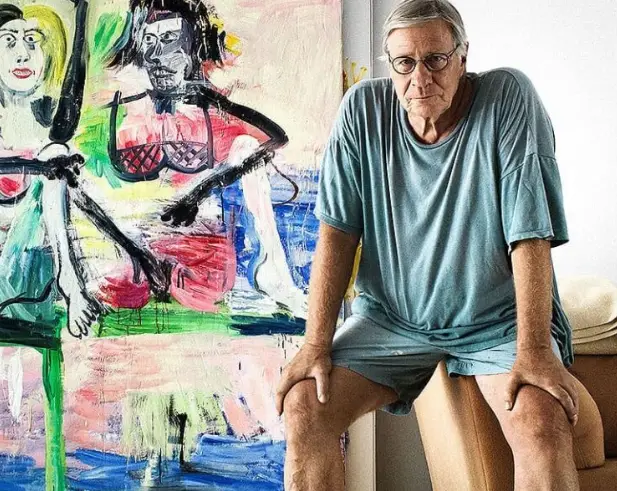
Louis Cane, born December 13, 1943 in Beaulieu-sur-Mer (Alpes-Maritimes) and died November 3, 2024 in Paris, was a contemporary French painter and sculptor. A member of the Supports/Surfaces group at the start of his career, his work has always oscillated between abstraction and figuration, reinterpreting the great works of art history.
In 1961, Louis Cane enrolled at the École nationale des arts décoratifs in Nice, then spent two years studying at the École nationale supérieure des arts décoratifs in Paris, from which he graduated in 1964 with a degree in “Mural Painting and Frescoes.”
In 1967-1968, along with Arman, Benjamin Vautier, Noël Dolla and Patrick Saytour, he exhibited “LOUIS CANE ARTISTE PEINTRE” (LOUIS CANE, PAINTER) at the Hall des Remises en question, a new venue opened by Ben in Nice. Together with Papiers collés (painted paper cut into thin strips and glued back onto a sheet of kraft paper), the stamps are the artist’s first works.
For the first group exhibition of the Supports/Surfaces group, Claude Viallat refused to allow Louis Cane to participate; Cane then distributed a theoretical text at the exhibition challenging the group’s cohesion—a pamphlet that marked the beginning of a series of controversies and protests.
The journal *Peinture, cahiers théoriques*, of which Louis Cane was one of the founders, was published in 1971, at a time when differences within the Supports/Surfaces group were becoming more pronounced. That same year, he held his first solo exhibitions in Paris (at the Daniel Templon Gallery and the Yvon Lambert Gallery) and participated in the second and third exhibitions of the Supports/Surfaces group at the Théâtre de la Cité internationale in Paris in April, and then in June at the Théâtre de Nice.
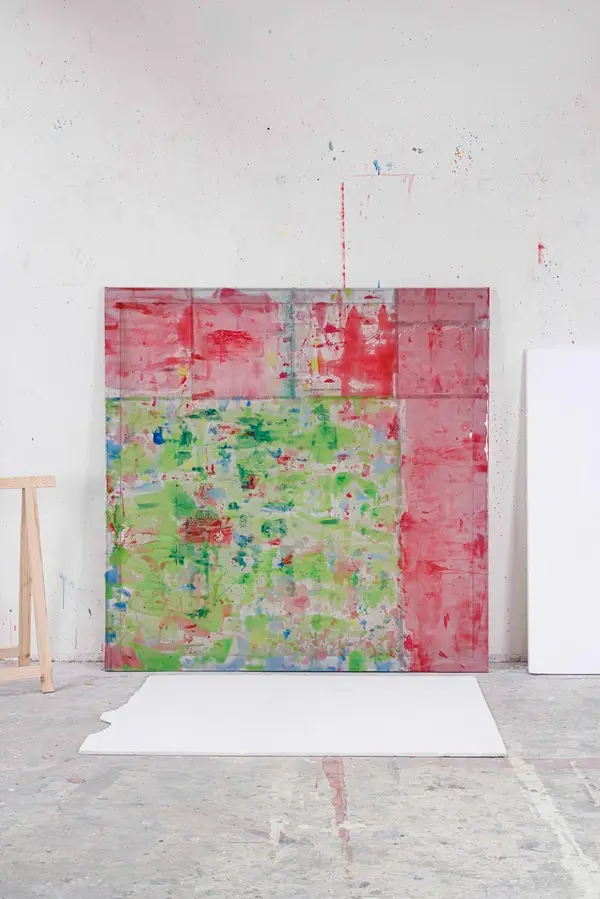
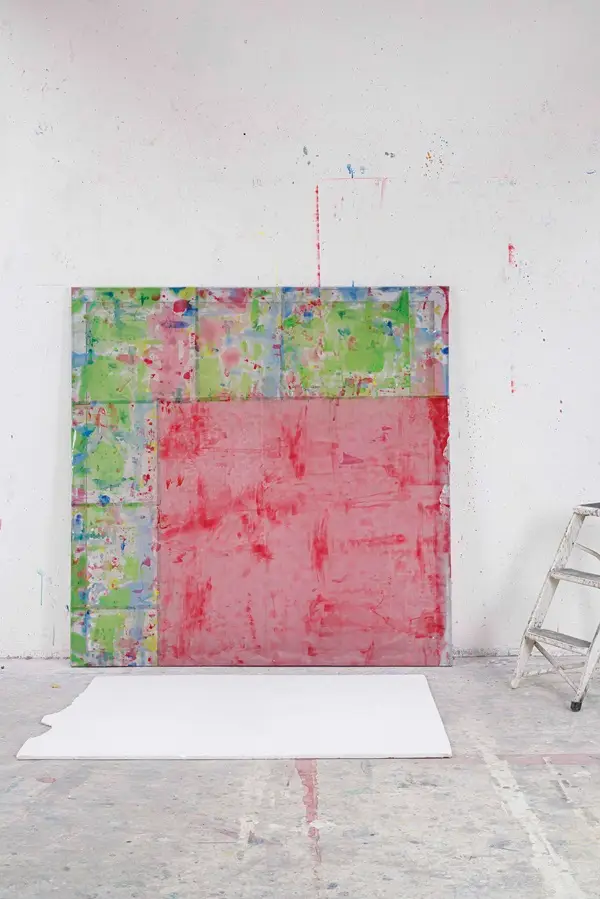
Until 1975, Louis Cane continued his abstract series: *Toiles découpées* beginning in 1970, unframed canvases spread out on the floor, then spray-painted and folded in half, and finally cut and stapled directly to the wall, followed by the *Toiles au sol* (Canvases on the Floor) from 1972, which explored space in painting and color theory, and finally the *Sol/Mur* series from 1974–1975, black canvases saturated with color through spray painting.
Between 1973 and 1978, he made numerous trips to Italy, where Raphael’s frescoes in the Vatican would influence him, and then studied classical painting, particularly that of Cimabue and Giotto.
In 1975 and 1976, he began to practice semi-abstract painting: his first drawings on the Meninas and his first canvases painted with arches, with the appearance of the angel. In 1977, he took part in the exhibition “L’avant-garde 1960-1976: trois villes, trois collections” (Marseille, Grenoble, Saint-Étienne and Centre Georges-Pompidou in Paris), which featured most of the artists of the Supports/Surfaces movement.
From abstract painting to a definitive return to figurative art in 1978, Louis Cane reflected on the history of pictorial forms and embarked on an intensely figurative exploration of iconic subjects: nude and dismembered women, childbirth scenes, Annunciations, and lunches on the grass… Cane has never hidden his sources: Picasso, Manet, Monet, Goya, Rembrandt, Matisse, Frank Stella, Jackson Pollock, and finally de Kooning.
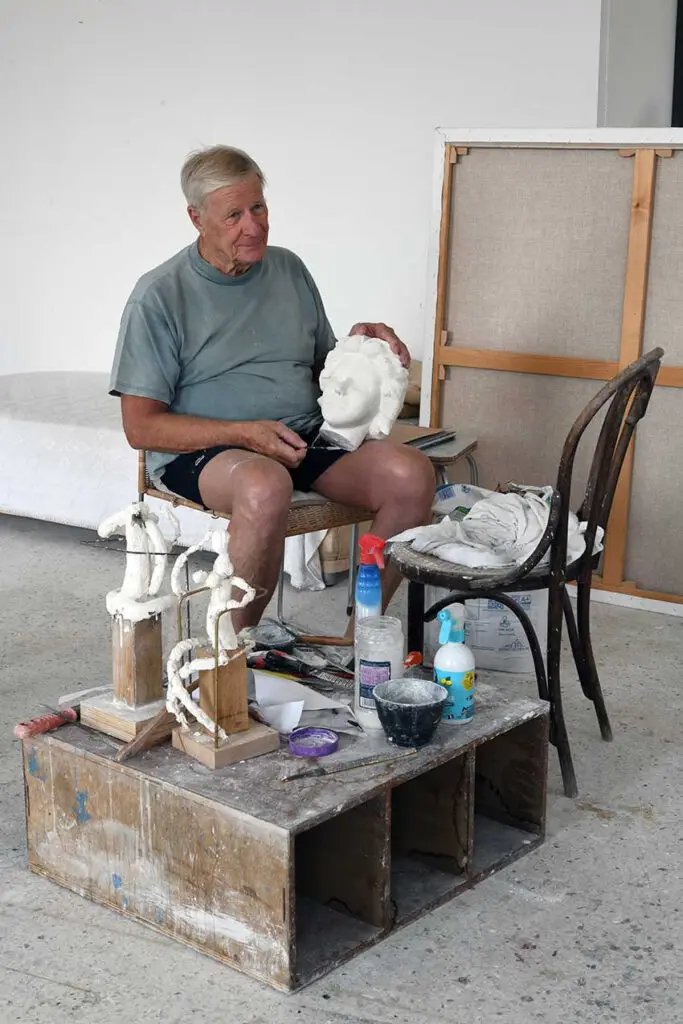
Sculpture, which he began in 1978, was a familiar discipline for him from his apprenticeship years. His statues, almost exclusively female, revive the traditional practice of modelling, and the forms are sometimes burlesque, sometimes pathetic, with a baroque expressionism. Examples include the Meninas series (inspired by Velasquez, among others), and Desmoiselles on a swing.
For the construction of the new Evry cathedral, he designed a modern, cubic tabernacle. It is covered on five sides with mosaics inspired by those of the early Church. The decorative themes are the symbols used by early Christians: dove, grape, bread, fish.
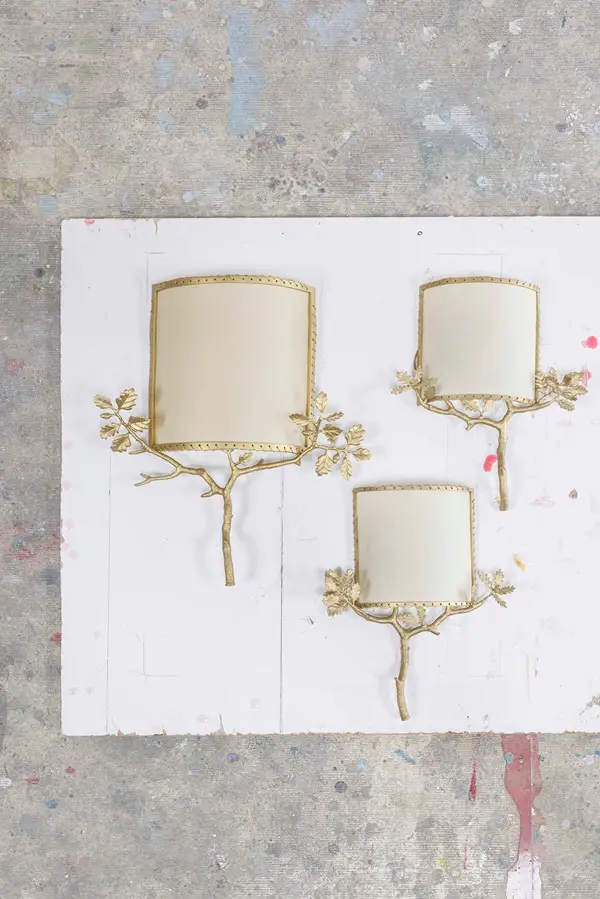
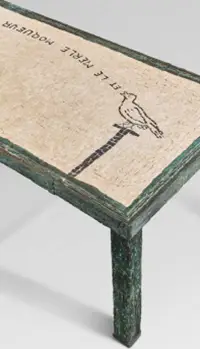
Louis Cane, who studied at the Arts Décoratifs, is also a furniture designer, this activity representing an important part of his artistic creation from the 1990s onwards.
Married since the 1970s to Nicole Cane, an animal sculptor[3], he died in Paris on November 3, 2024, at the age of 80.